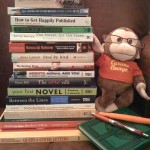
 Books on Writing: Part 1
Whisper the words books on writing to a bunch of writers and you might have to watch the whoosh of air as they take sides so fast it’s like being transported to West Side Story.
Jets: “Books, I don’t need no stinking how-to-learn-to-write books. Long as I have John Gardner, I’m fine.â€
Sharks: “I can’t hear you over this stack of books on writing stacked in front of me.â€
Me? I love astute books on writing. Over the years, they’ve offered commonsense techniques, given succor when I wept over rejection letters, and taught me ways to use the hundred-dollar technical writing words used by smarter writers.
Books on writing can be divided into the before, books that interest you before and during the process of writing, Â and after, books that become your bible when you are trying to sell your work.
Part 1.
Before: Technique, Tools, and Support
TOXIC FEEDBACK: Helping Writers Survive and Thrive by Joni B. Cole.
Joining a good critique group, writer’s group, or writer’s workshop is often a frightening move for a beginning (or not-so-beginning) writer. Cole’s enjoyable book speaks to the good and bad of both sides of this process, making this a great book for both teachers and participants.
THE MODERN LIBRARY WRITER’S WORKSHOP: A Guide to the Craft of Fiction by Stephen Koch
Reading this book is like having the best kind of writing teacher—kind, smart, clear—talking you through the rough spots and teaching you why you need motivation, action, clarity in your writing and how to go about getting it. Plus, Koch included advice from writer’s ranging from Ray Bradbury to Samuel Johnson.
BETWEEN THE LINES: master the subtle elements of fiction writing by Jessica Morrell
A gifted and experienced teacher, Morrell offers a full tour through writing a novel, starting with Chapter 1: Art & Artifice: Keeping Readers Spellbound, through Chapter 18: Transition. She had me at her chapter headings.
WRITING FICTION: A Guide to Narrative Craft by Janet Burroway
Burroway “attempts to guide the student writer from the first impulse to final revisions, employing concepts of fiction elements familiar from literature’s study, but shifting the perspective towards that of the practicing writer.†A thorough book. Very.
ON WRITING by Stephen King.
King weaves the story of his journey to becoming a writer, his life changing near death experience, and his struggle to overcome addiction with top-notch writing advice. Write much? Read. This. Book.
bird by bird: Some Instructions on Writing and Life by Anne Lamott
Lamott covers not only the writing basics (with clarity and humor) she also reveals the writer’s underbrush: jealousy, self-doubt, self-deprecation, depression, anxiety, and waiting. What a glamorous life writers have, eh?
SELF-EDITING FOR FICTION WRITERS: How to edit yourself into print by Renni Browne and Dave King.
What William Strunk and E.B. White does for anything and everything requiring The Elements of Style, Browne and King do for fiction. What? You don’t already own this???
THE ARTFUL EDIT: On The Practice of Editing Yourself by Susan Bell
Bell wrote a fascinating book in which Bell uses Max Perkins editorial collaboration with F. Scott Fitzgerald as a teaching tool about the fundamentals of editing. Read. Reread. She also includes interviews with writer such as Ann Patchett and Tracy Kidder.
: Revision Techniques No Fiction Writer Can Afford to Ignore by Elizabeth Lyon.
Lyon’s book bridges the ‘before’ and ‘after’ of writing your book, first outlining tools for a smart revision and rewrite, and then providing the how-to of preparing your manuscript (including suggestions for font and point!) and queries.
Next: Part 2